
Bowfin Basics
By R.W. Wolffreprinted from American Currents, Fall 1996
If you're in the market for one of North America's magnificent oddballs, it's hard to beat the bowfin, Amia calva. Deriving from an ancient lineage, the bowfin shares traits with both primitive and advanced fish. Although they care for both eggs and fry, these fascinating creatures have never been bred in a home aquarium--offering some pioneering aquarist the chance to be the first to spawn them.
Found in much of the eastern half of the United States, the bowfin prefers slow creeks and the tannin-dark waters of acid-cedar swamps. Ancestors of the bowfin date as far back as the Jurassic period. The genus Amia was once found on most continents and some members of the family were even found in salt water. Today, however, Amia calva is the sole survivor of this once widespread clan.
The bowfin is a "transitional" fish--similar to its relatives the gars, but also sharing traits with the more advanced bony fishes. Like the gars, the bowfin has a largely cartilaginous skeleton. But like the more highly evolved bony fishes, the bowfin has vertebrae that are amphicoelous, or concave at each end. Along with the gars, the bichirs are the bowfin's other living relatives.
The bowfin is a long-bodied fish, about the same height from head to tail. The dorsal fin extends across much of the body; the caudal fin is rounded. The bowfin has a highly developed swimbladder that allows it to gulp air at the water's surface--a definite advantage under low oxygen conditions. Like sharks, bowfins have retractable teeth that remain hidden when the mouth is closed but are exposed when the fish is biting down. The fish's skull also flattens out, to allow them to swallow flat-bodied fish, like sunfish. Favorite foods include crayfish, shad, golden shiners, perch, suckers, and other narrow bodied fish.
Among fishermen, the bowfin is the Rodney Dangerfield of American fishes, never accorded any respect. Many anglers regard it as a "trash fish" that competes with game fish for food. Hooked bowfin are often thrown on the bank to die. In fact, this lack of respect is patently unfair. Hooked bowfin fight as hard as--maybe even better than--any game fish. And adult bowfin can reach trophy size--almost a yard in length and weighing more than 30 pounds.
Such behemoths are, of course, too large for the home aquarium. But the young can be collected almost any time of year, either in the weed beds, in warmer weather, or at creek mouths or openings in the ice in winter. I prefer to start with one-and-a-half to two inch fish. Bowfins I've kept seem to prefer soft water with a pH of 6.8, a temperature of 75 degrees and full spectrum lighting of medium intensity. It's best to set them up in a half-filled 20 gallon long aquarium, with a thick carpet of low plants and an upper covering of floating plants. The dense plant growth provides the skittish young bowfins a sense of security, assuring that they will have less fear of you as they acclimate to their new surroundings. For filtration, I prefer a filter that creates a strong surface current, but with a medium overall tank current.
For the initial feedings, chopped earth worms and shrimp will soon be eagerly accepted. In about a week, they will have acclimated to tank life. As you approach the aquarium, they will swim to the surface in anticipation of their next feeding. About this time, you can introduce them to prepared foods. At first, I offer them some freeze dried tubifex worms, breaking the cube into one-eighth inch pieces. In another three days, I usually start giving them sinking shrimp pellets. The young bowfins will cruise the bottom, inhale the pellets and then hide among the weeds while chewing the pellets up.
Throughout the next month, you can introduce more different types of prepared foods as the fish become more and more accustomed to tank life. If they fail to eat enough of the new food, you can fall back on the chopped worms and shrimp. After the fish accept more types of food and gain more confidence, you can add more water to the tank. About this time, the young bowfins will come to the surface when you splash your finger in the water. At this time, you can introduce them to ground beef, beef heart, and beef liver. Such a highly varied diet will improve the color and growth patterns of the young fish.
Feed the fish twice a day for the first six months. After this time, they should be about 4 to 6 inches in length. Now, you can move them to larger quarters, to a tank containing from 40 to 55 gallons of water. More shallow, wider, tanks are best. I've found that at this stage, spotted gar make excellent tank mates. Bowfins are highly social, and you will see them holding in dense weeds, stacked together like cord wood. Within about a year, the bowfins will reach their maximum captive size of 12 to 16 inches.
In the winter, you may need to subject fish from Northern areas to an extended period of cold temperature (below 50 degrees). Fish not wintered over in this way will eat less and be less active.
Be careful when feeding larger fish, though. They have sharp teeth and very powerful jaws (as any fisherman who has unhooked one can tell you.)
At about this time, also, you will be able to tell the males and females apart. The males have an ocellus on the tail and green pectoral, ventral, and anal fins. The females will have either a black spot or no noticeable spots in the upper tail. Their pectoral, ventral, and anal fins will be grey to brown. In most cases, the males grow faster than the females in the first year. Some fish will develop a blood-red lower third of the caudal fin. On fish with dark markings, this is normal. Moreover, some males will develop extra ocelluses. I've seen up to three (this is very rare).
I'm not aware of anyone having spawned the bowfin in the home aquarium. With the technique I've described here, and with a high-quality diet, the time is right for captive bred bowfins. In the wild, breeding takes place when water temperatures reach about 72 degrees. Typically, the male will seek out an area near an old log or large rock, to provide cover for one side of the nest. Next, he will chew the tops off any reeds in the area before fanning out a depression about 2 feet wide and 5 inches deep. He will also vigorously defend his nest against any rival males.
At night, the male will attract one female at a time into the nest to spawn, with the female laying many green, adhesive eggs in the nest. The eggs, each about 3/16ths of an inch in diameter, adhere to the roots at the bottom of the nest. Males may subsequently spawn with up to three other females. Eventually, the nest may contain up to 5,000 eggs and fry in various stages of development. The male will fan the eggs to keep water circulating over them. The eggs hatch in 2 to 6 days, depending on sunlight and temperature.
The babies will stick together in a tight group as their father escorts them along the shoreline in search of food. The male will warn the group of approaching danger by splashing his tail against the water's surface. Commonly, groups of baby bowfins will combine to form aggregations up to 5 feet long and 3 feet wide. The defending males will usually hover underneath these large swarms. After a few weeks, the males will discontinue gaurding and the group will disperse.
At this time, all the baby fish have a distinct ocellus on the tail. With time, the females will lose the ring around the tail spot, and in some waters the entire spot fades away with age. Although males will outgrow the females in the first year of life. Thereafter, females will surpass them, with males only reaching a maximum length of 25 inches, as compared to the females length of up to 38 inches. As they age, the females become a dull gray or green, whereas the older males may develop some of the most vivid and striking colors of any bowfin.
In my view, the bowfin has been shown no respect for long enough. As friendly as Oscars, the bowfin is a prime candidate for aquarium life and the time is near to spawn these captivating giants in the home aquarium.
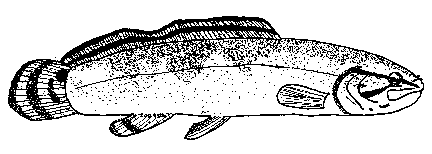
bowfin Amia calva
drawing by Robert Bock
Used with permission. Article copyright retained by author.